Dispossesions in the Americas

Dispossesions in the Americas

  • Home
  • Explore
  • About
  • Authors
  • Art
  • Bodies
  • Curricula
  • Cultural Heritage
  • Maps
  • Territories
Back to Explore
Artwork

Amazonía [Amazon]

  • Yahuarcani, Santiago

Published: 2016

Media: Natural dyes and acrylic on llanchama

  • Download Image

Abstract

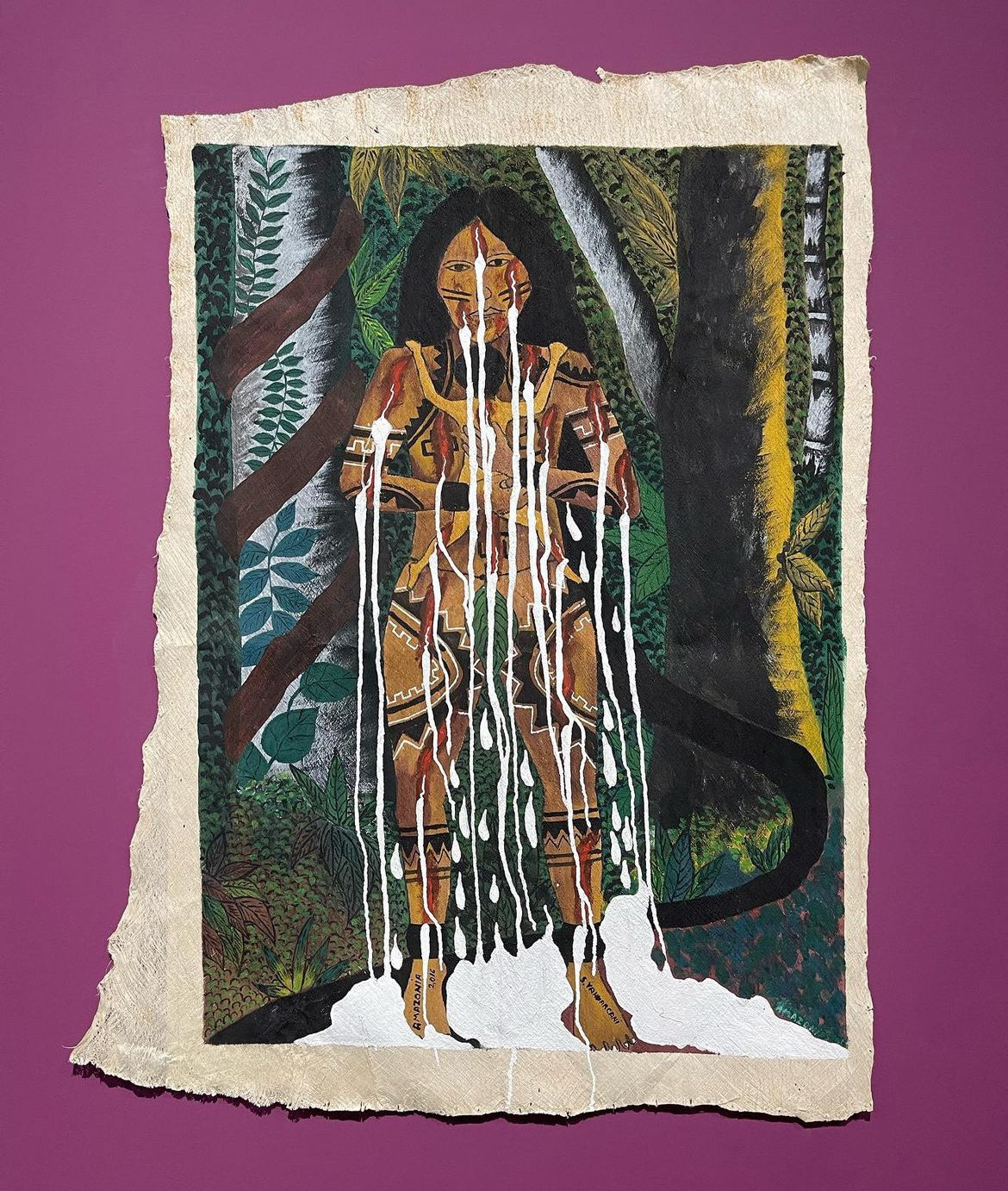
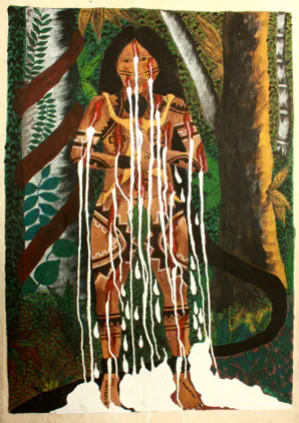
This artwork celebrates and preserves the Uitoto-Aimeni community’s cultural heritage and its close relationship with the Amazonian territory, making it a significant artistic representation of both dimensions. The body decorations and natural dyes used in the painting are specific cultural elements that convey the identity and heritage of this community. Including elements from the Amazonian flora and fauna in the artwork, such as ferns and the snake, establishes a visual and spiritual connection with the Amazonian territory.

This painting is a portrait that celebrates the culture of the Uitoto-Aimeni Indigenous community in the Peruvian Amazon. In the center of the artwork, an Indigenous woman embodies the essence of the Amazon rainforest. Her body decorations, created with natural dyes, are a testament to her cultural identity and symbolize this community’s deep connection with its environment. The woman is surrounded by ferns, snakes, and other elements of the Amazonian flora and fauna, emphasizing the community’s close relationship with nature. This painting pays tribute to the beauty and diversity of the rainforest and the rich cultural heritage of the Uitoto-Aimeni community, which has preserved its traditions and profound connection to the Amazonian territory across generations.
  • Download Image

Reading in Spanish

Artwork

Amazonía

  • Yahuarcani, Santiago

Published: 2016

Media: Tintes naturales y acrílico sobre llanchama

  • Download Image
  • Download Image

Reading in Portuguese

Artwork

Amazonía [Amazônia ]

  • Yahuarcani, Santiago

Published: 2016

Media: Tintas naturais e acrílico sobre yanchama

  • Download Image

Resumo

Esta obra celebra e preserva o patrimônio cultural da comunidade Uitoto-Aimeni e sua relação de proximidade com o território amazônico, tornando-a uma representação artística significativa das duas dimensões. Os enfeites do corpo e as tintas naturais utilizadas na pintura são elementos culturais específicos que transmitem a identidade e a herança desta comunidade. Incluindo elementos da flora e da fauna amazônica, como a samambaia e a serpente, a obra estabelece uma conexão visual e espiritual com o território amazónico.

Esta pintura é um retrato que celebra a cultura da comunidade Indígena Uitoto-Aimeni, na Amazônia peruana. No centro da obra, uma mulher Indígena encarna a essência da selva amazônica. Os enfeites no corpo, feitos com tintas naturais, são um testemunho de sua identidade cultural e simbolizam a profunda conexão de sua comunidade com o meio ambiente. A mulher está rodeada de samambaias, serpentes e outros elementos da flora e da fauna amazônicas, enfatizando a estreita relação da comunidade com a natureza. Esta pintura é uma homenagem à beleza e diversidade da selva e ao rico patrimônio cultural da comunidade Uitoto-Aimeni, que tem preservado suas tradições e estreita relação com o território amazônico ao longo das gerações.

  • Download Image

Related Content

Rivers can exist without waters but not without shores

Rivers can exist without waters but not without shores

Art Exhibit 2022
Who Can we Be, Who Can we Become, After all this Blood:
An Embodied Philosophical Pursuit of the Potentiality of the Marginalized’s Capacity for Coherence, for Survival,  in the Wake of Colonial Rupture

Who Can we Be, Who Can we Become, After all this Blood: An Embodied Philosophical Pursuit of the Potentiality of the Marginalized’s Capacity for Coherence, for Survival, in the Wake of Colonial Rupture

Narrative

Dispossessions in the Americas

A project by

University of Pennsylvania

Copyright 2024

With support from

Mellon Foundation

Site design & development

Element 84

Site Pages

  • Home
  • Explore
  • About
  • Authors
  • Art
  • Bodies
  • Curricula
  • Cultural Heritage
  • Maps
  • Territories