Abstract
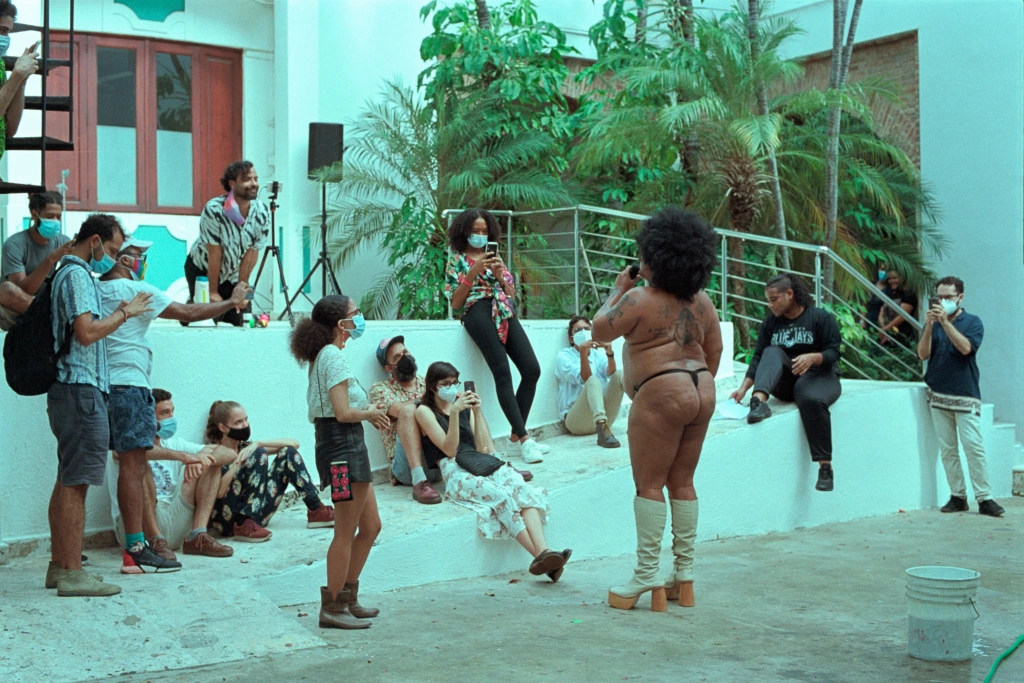
At the center of Johan Mijail’s work lies the body as a site of inscription, vulnerability, and resistance. Reimagining Frank Báez’s poem La Marilyn Monroe de Santo Domingo, Mijail positions himself as the “authentic Marilyn Monroe of Santo Domingo,” a travesti whose existence unfolds on the margins. Through confessional prose and a performative rewriting, body and poetry fuse in a ritual that destabilizes gender boundaries and social norms. His 2016 poetic action in Santiago de Chile, performed naked in white heeled boots, exemplifies this embodiment: a spoken word ritual where identity dissolves between the masculine and the feminine. Details such as smeared makeup and stockings simulating breasts expose the fragility and force of self-construction. More than autobiography, Mijail’s work enacts a corporeal critique of gender stereotypes, staging the body as both intimate confession and collective resistance.
Johan Mijail’s text, deeply confessional and laden with powerful imagery, explores identity and gender boundaries through the iconic figure of Marilyn Monroe, reimagined in the context of Santo Domingo. Through his words, Johan identifies himself as the “authentic Marilyn Monroe of Santo Domingo,” a misunderstood and poetic travesti who lives his reality on the margins. In this rewriting of Frank Báez’s poem, titled La Marilyn Monroe de Santo Domingo, Mijail unfolds a narrative in which body and poetry merge into a kind of performative ritual, full of symbols and ceremonies. The author recounts how, in 2016, he carried out a poetic action in Santiago de Chile, where his body became the vehicle of his poetry. Naked and wearing white high-heeled boots, he performed a spoken word piece in which his identity blurred between the masculine and the feminine, giving life to that “quasi-woman” described in his work. The scene, captured in a fixed shot against the backdrop of the everyday, like the washing of a car, plays with the tension between the intimate and the public, the ritualistic and the mundane. The reference to his physical transformation, with details such as makeup smeared by tears and sports stockings simulating breasts, emphasizes the vulnerability of the author in the process of reinterpreting his own body and experiences. This act, though personal, resonates with a broader critique of gender stereotypes and the social pressures that condition these identities. Through his raw prose and uninhibited style, Johan Mijail reveals a ritual of self-exploration, where body and spirit confront the mirror of society in a search for authenticity that defies established norms.
Citation
Mijail, Johan. 'Una de las Postales Mentía [One of the Postcards Lied]'. Dispossessions in the Americas. https://staging.dia.upenn.edu/en/art/AMEX014/