Dispossesions in the Americas

Dispossesions in the Americas

  • Home
  • Explore
  • About
  • Authors
  • Art
  • Bodies
  • Curricula
  • Cultural Heritage
  • Maps
  • Territories
Back to Explore
Artwork

TAJO [SLASH]

  • Hincapié Charry, Marta

Media: Performance

  • Download Image

Abstract

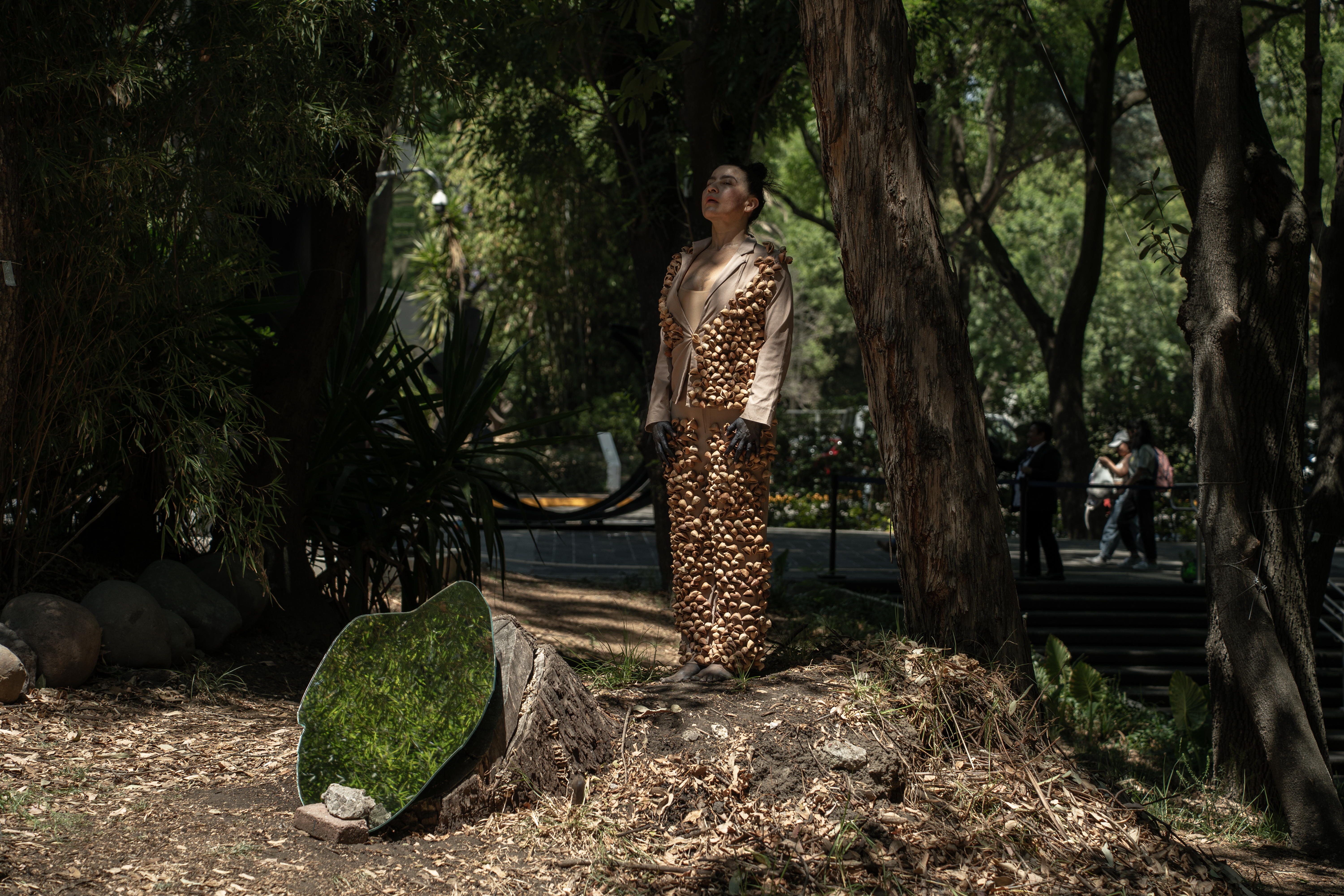
TAJO is a site-specific performance that explores the relationship between body, earth, and territory. By opening a cut (tajo) in the ground and transferring a portion of soil into the museum space, the artist symbolically reconnects the interior and exterior, challenging the separation between nature and institution, land and representation. The performance foregrounds the earth as a living, political presence, one shaped by colonial extraction, cultural erasure, and human disconnection. Dressed in a suit adorned with seeds, the artist invokes the sun in ritual movement, transforming her body into a tool of reconnection. The mirror shaped like a felled tree becomes both shield and reflection, referencing environmental loss and ancestral memory. TAJO reclaims the territory not as passive landscape but as an agent of history, knowledge, and presence. By making the soil visible and central within the museum, the work demands a renewed recognition of the land. Not as background, but as protagonist in the ongoing struggle over space, identity, and belonging.

From the Earth to the Earth. TAJO evokes our perception of the soil—the cultural, colonial, and humanistic roles that shape our relationship with the land. TAJO speaks to the earth’s omnipresence and to the ways we both acknowledge and deny it.

Dressed in a suit adorned with seeds, I begin a sun salutation in the garden. A mirror shaped like the silhouette of a felled tree accompanies me on a walk, as if it were a shield. With a shovel, I open a tajo—a gash—in the earth, and I myself become a tool, transferring a portion of soil toward the center of the dome. In doing so, I allow this patch of earth to enter the Museum, granting it the possibility of being observed from within, known, and stood upon. Through movement, I invoke the sun, as the seeds produce sounds that amplify my actions.

In my recent body of work, the earth has always been present, relating in different ways to visitors, to the space, and to myself. When placed at the center, as protagonist, our perception of it is renewed. Upon visiting (initially virtually) the Museum and its gardens, it became clear to me that I was being called to connect the inside and the outside in a way that might seem obvious—yet is often normalized, uncomfortable, unexpected, or rather, unwelcome.

TAJO is a newly commissioned piece for the inSURrecciones gathering, presented in the gardens of the Museum of Modern Art in Mexico City.

Citation

Hincapié Charry, Marta. 'TAJO [SLASH]'. Dispossessions in the Americas. https://staging.dia.upenn.edu/en/art/AMEX003/
  • Download Image

Reading in Spanish

Artwork

TAJO

  • Hincapié Charry, Marta

Media: Interpretación artística

  • Download Image
  • Download Image

Reading in Portuguese

Artwork

TAJO [TALHO]

  • Hincapié Charry, Marta

Media: Interpretação artística

  • Download Image

Resumo

TAJO é uma interpretação artística sítio-específico que explora a relação entre o corpo, a terra e o território. Ao abrir um corte (talho) no solo e transladar uma porção de terra para o interior do museu, a artista reconecta simbolicamente o interior com o exterior, desafiando a separação entre natureza e instituição, terra e representação. A interpretação artística coloca a terra como uma presença viva e política, marcada pela extração colonial, o apagamento cultural e a desconexão humana. Vestida com um traje enfeitado com sementes, a artista invoca o sol mediante um movimento ritual, transformando seu corpo em uma ferramenta de reconexão. O espelho, com forma de árvore cortada, funciona ao mesmo tempo como escudo e reflexo, fazendo referência à perda ambiental e à memória ancestral. TAJO reivindica o território não como uma paisagem passiva, mas sim como um agente da história, do conhecimento e da presença. Ao tornar visível e central a terra dentro do museu, a obra exige um reconhecimento renovado do solo; não como pano de fundo, mas sim como protagonista na luta contínua pelo espaço, a identidade e o senso de pertencimento.

Da terra para a terra. TAJO evoca a nossa percepção do terra; o papel cultural, colonial e humanístico que desempenha nossa relação com ela. TAJO faz referência à sua natureza omnipresente e às formas como a concebemos e negamos. Com meu traje enfeitado com sementes inicio as saudações ao sol no jardim. Um espelho que imita a silhueta de uma árvore cortada me acompanha na caminhada como se fosse um escudo. Com uma pá, abro um talho na terra, e eu mesma sirvo de ferramenta trasladando uma porção extraída do solo para o centro do domo, introduzindo este solo de terra no museu, dando-lhe a possibilidade de ser observado interiormente, de conhecê-lo e de se apoiar sobre ele. Em movimento, faço uma invocação ao sol e as sementes produzem sons que amplificam minhas ações. Em meu trabalho dos últimos anos a terra tem estado sempre presente relacionando-se com os assistentes/visitantes, com o espaço e comigo. Ao ficar a terra no foco como protagonista, nossa percepção se renova. Nesta ocasião, ao visitar (inicialmente de forma virtual) o prédio do museu e seus jardins, ficou claro para mim o chamamento para conectar o interior com o exterior de uma forma talvez óbvia, mas ao mesmo tempo normalizada, bem como desconfortável, inesperada ou, melhor, indesejada. TAJO é a peça inédita patrocinada pelo encontro inSURrecciones para ser apresentada nos jardins do Museu de Arte Moderna da Cidade do México.

Citation

Hincapié Charry, Marta. 'TAJO [TALHO]'. Dispossessions in the Americas. https://staging.dia.upenn.edu/pt/art/AMEX003/

  • Download Image

Related Content

inSURrecciones: Reflections on decolonial performativities

inSURrecciones: Reflections on decolonial performativities

Art Exhibit 2024

Dispossessions in the Americas

A project by

University of Pennsylvania

Copyright 2024

With support from

Mellon Foundation

Site design & development

Element 84

Site Pages

  • Home
  • Explore
  • About
  • Authors
  • Art
  • Bodies
  • Curricula
  • Cultural Heritage
  • Maps
  • Territories