Dispossesions in the Americas

Dispossesions in the Americas

  • Home
  • Explore
  • About
  • Authors
  • Art
  • Bodies
  • Curricula
  • Cultural Heritage
  • Maps
  • Territories
Back to Explore
Artwork

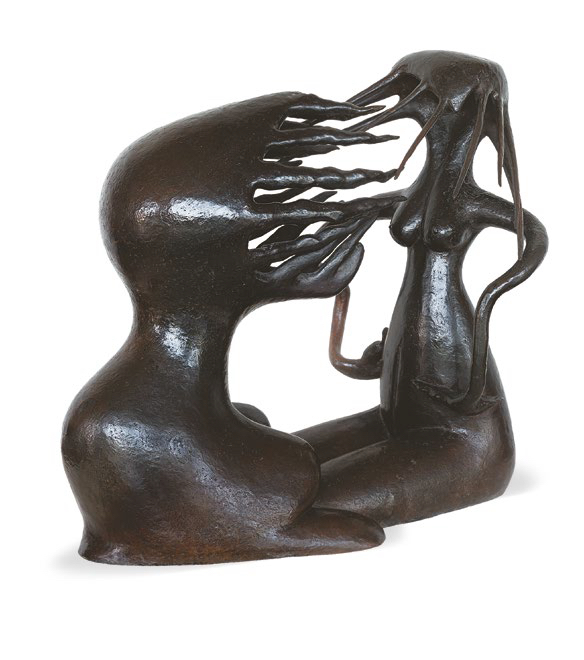
O impossível [The Impossible] Museum of Modern Art of Rio de Janeiro Donated by the artist

  • Martins, Maria

Published: 1945

Media: Bronze sculpture 79,5 x 80 x 43,5 cm

  • Download Image

Abstract

Martins’ work intertwines organic and surreal elements, reflecting the era’s exploration of the subconscious. In “O Impossível,” the morphological fusion of plant and human-like forms symbolizes the interconnectedness of nature and humanity. This dual identity mirrors Brazil’s diverse cultural landscape and the coexistence of Indigenous roots with modern influences. Martins’ sculpture contributes to the broader discourse on identity, nature, and the enigmatic aspects of Brazilian modern art.

Maria Martins’ sculpture “O Impossível” (1945) holds a significant place in Brazilian modernity, especially within the context of Surrealism. As a prominent figure in the Brazilian art scene, Martins engaged with international artistic movements. Her work intertwines organic and surreal elements, reflecting the era’s exploration of the subconscious. In “O Impossível,” the morphological fusion of plant and human-like forms symbolizes the interconnectedness of nature and humanity. This dual identity mirrors Brazil’s diverse cultural landscape and the coexistence of Indigenous roots with modern influences. Martins’ sculpture contributes to the broader discourse on identity, nature, and the enigmatic aspects of Brazilian modern art.

Citation

Martins, Maria. 1945. 'O impossível [The Impossible] Museum of Modern Art of Rio de Janeiro Donated by the artist'. Dispossessions in the Americas. https://staging.dia.upenn.edu/en/art/ABRA030/
  • Download Image

Reading in Spanish

Artwork

O impossível [Lo imposible] Museo de Arte Moderna de Río de Janeiro Donación del artista

  • Martins, Maria

Published: 1945

Media: Escultura de bronce 79,5 x 80 x 43,5 cm

  • Download Image
  • Download Image

Reading in Portuguese

Artwork

O impossível

  • Martins, Maria

Published: 1945

Media: Escultura de bronze 79,5 x 80 x 43,5 cm

  • Download Image

Resumo

A obra de Martins entrelaça elementos orgânicos e surrealistas, refletindo a exploração do subconsciente característica da época. Em “O Impossível”, a fusão morfológica de formas vegetais e humanoides simboliza a interconexão entre a natureza e a humanidade. Essa identidade dual reflete a diversidade cultural do Brasil e a coexistência de raízes Indígenas com influências modernas. A escultura de Martins contribui para o discurso mais amplo sobre identidade, natureza e os aspectos enigmáticos da arte moderna brasileira.

A escultura “O Impossível” (1945), de Maria Martins, ocupa um lugar significativo na modernidade brasileira, especialmente no contexto do surrealismo. Figura de destaque na cena artística brasileira, Martins participou ativamente dos movimentos artísticos internacionais. Sua obra entrelaça elementos orgânicos e surrealistas, refletindo a exploração do subconsciente própria da época. Em “O Impossível”, a fusão morfológica de formas vegetais e humanoides simboliza a interconexão entre a natureza e a humanidade. Essa identidade dual reflete a diversidade cultural do Brasil e a coexistência de raízes Indígenas com influências modernas. A escultura de Martins contribui para o discurso mais amplo sobre identidade, natureza e os aspectos enigmáticos da arte moderna brasileira.

Citation

Martins, Maria. 1945. 'O impossível'. Dispossessions in the Americas. https://staging.dia.upenn.edu/pt/art/ABRA030/

  • Download Image

Related Content

Nakoada: Strategies for Modern Art

Nakoada: Strategies for Modern Art

Art Exhibit 2024

Dispossessions in the Americas

A project by

University of Pennsylvania

Copyright 2024

With support from

Mellon Foundation

Site design & development

Element 84

Site Pages

  • Home
  • Explore
  • About
  • Authors
  • Art
  • Bodies
  • Curricula
  • Cultural Heritage
  • Maps
  • Territories