Abstract
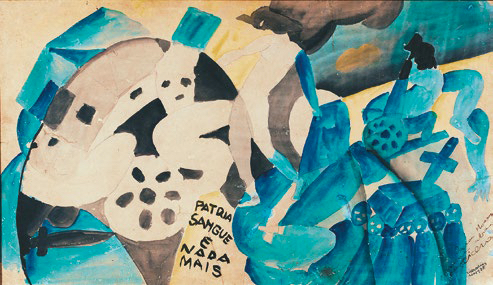
Cícero Dias’ “Pátria, sangue e nada mais” (1928) becomes a canvas that explores the intersection of territory and cultural heritage. The watercolor and graphite composition, with its symbolic elements and muted palette, creates a landscape rich in cultural significance. The inclusion of a knife, figures carrying a coffin, and scattered limbs hints at deeper narratives of struggle and sacrifice. The inscription, “Pátria, sangue e nada mais,” elevates the artwork to a reflection on homeland, blood, and the complex layers of national identity. Through this composition, Dias engages viewers in a contemplative journey, prompting reflections on the intertwined aspects of territory and cultural heritage.
Cícero Dias’ “Pátria, sangue e nada mais” from 1928 is a watercolor and graphite composition measuring 29.6 x 51 cm. In this artwork, a subtle yet poignant abstraction unfolds. Elements such as a knife, people carrying a coffin, and scattered limbs evoke a landscape steeped in symbolism. The predominant hues of blue and black, despite the delicate texture of the watercolor, contribute to the portrayal of a scene marked by death and violence. The inscription on the piece, “Pátria, sangue e nada mais” (Homeland, blood, and nothing more), adds a layer of meaning, inviting contemplation on themes of patriotism and the human condition.
Citation
Dias, Cícero. 1928. 'Pátria, sangue e nada mais [Homeland, Blood and Nothing More]'. Dispossessions in the Americas. https://staging.dia.upenn.edu/en/art/ABRA010/